Surface Texture and Tonal Transitions: What to Inspect in High-Efficiency Retouching Workflows
Luminance separation, micro-contrast retention, and edge definition dictate whether an automated pipeline can speed up photo retouching without losing detail during high-volume production. Luminance separation isolates transient epidermal marks from the underlying volume of a face, making it the critical factor when determining whether an acceleration tool preserves physical reality or merely blurs high frequencies into an artificial wash. When explaining workflow efficiency to an editor or client, pointing to generic concepts like “natural results” is rarely convincing. Instead, you need clear visual markers on the canvas that demonstrate exactly where automated or accelerated tools succeed and where their mechanical assumptions begin to break down.
Direct Visual Indicators at 100 Percent Zoom
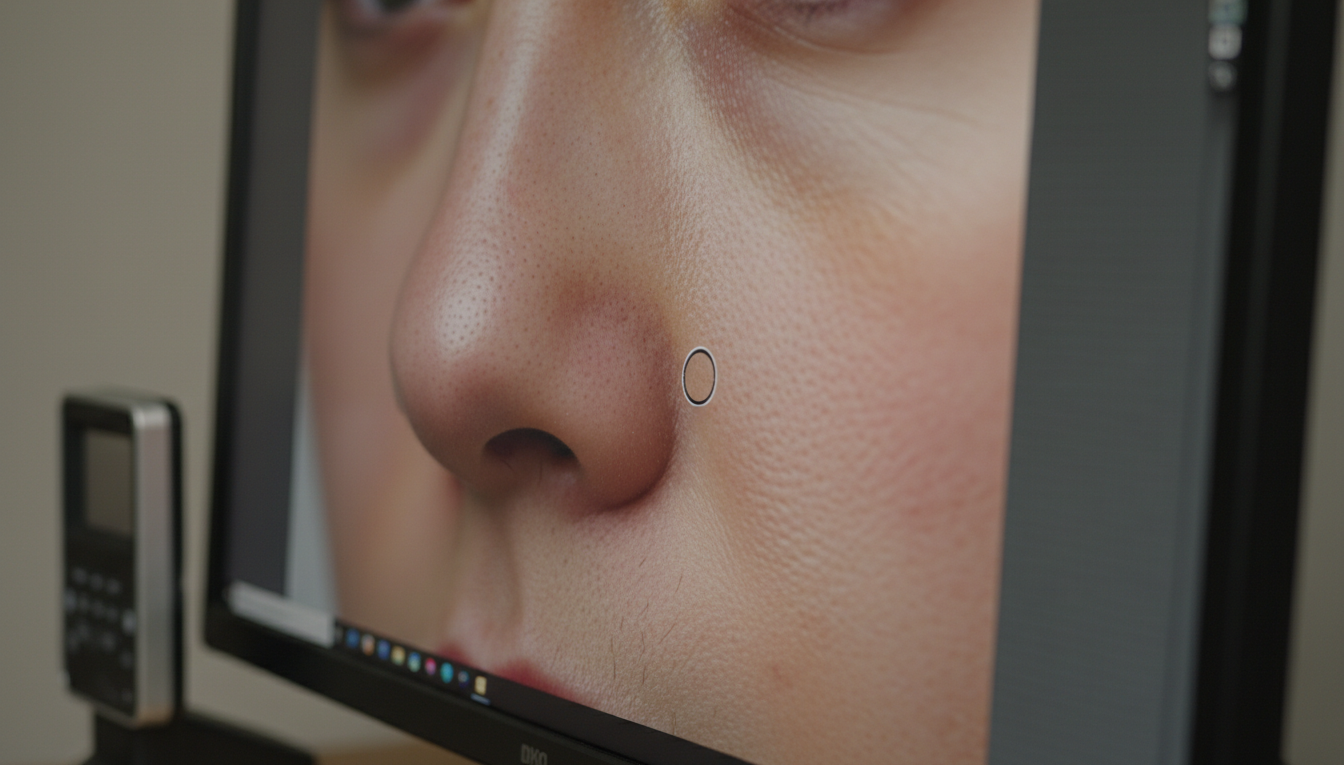
The first indicator to inspect before judging an accelerated pass is the boundary of local skin pores and hair follicles under full magnification. In a destructive smoothing operation, pixel values across adjacent high-frequency areas are averaged out, resulting in a loss of dermal elevation. A non-destructive acceleration technique, whether through neural segmentation or scripted frequency division, retains the dark and light rims around individual pores while adjusting only the uneven redness or blotchiness underneath. If the porous structure appears suspended over a flat, plastic plane without depth, the tool has flattened the intermediate tonal transitions rather than cleaning the surface.
The second checkpoint lies along transition zones where hard anatomy meets soft skin, particularly the vermilion border of the lips, the contours of the nostrils, and the fine lines around the lower eyelids. Automated batch actions frequently misinterpret these organic boundaries as tonal blemishes. To demonstrate this to a colleague, zoom in directly on the transitional line between the nasal wing and the cheek: an overzealous script will soften the shadow falloff, creating a muddy or smudged transition that strips the face of structural weight. Observing this edge confirms whether the software respects anatomical form or blindly applies local low-pass filtering.
A Controlled Example: Inspecting an Overexposed Commercial Close-Up
Consider a hypothetical commercial studio portrait of an actor shot with a high-resolution sensor and directional key light, where minor flaking and makeup caking appear across the bridge of the nose. In a manual workflow, resolving this requires several minutes of targeted cloning with a soft stamp at low opacity, sampling clean skin grain from adjacent cheek areas.
If you route this portrait through an automated blemish removal script to cut editing time from ten minutes down to thirty seconds, the software scans the zone for high-contrast deviations. In this hypothetical test, the algorithm successfully removes the isolated makeup flakes, but because the directional lighting creates high specular micro-reflections across the nasal bone, the tool mistakes these tiny highlight points for whiteheads or dust. It replaces them with adjacent midtone skin data. The result is a nose that looks clean at fit-to-screen view, yet at 100 percent, the natural highlights that give the bridge its physical sharpness are completely gone. This test illustrates the upper limit of relying purely on speed: algorithmic tools excel at isolated, standard contrast deviations, but struggle when texture and high-key specular highlights inhabit the exact same frequency band.
The Trade-Off Between Manual Precision and Processing Throughput
Evaluating automated retouching tools is never a question of declaring automation superior to hand work, or vice versa; it is an assessment of production volume against individual asset tolerance. Manual frequency separation and micro-dodge-and-burn provide complete control over every pixel’s tonal value, ensuring that no eyelash is blurred and no natural freckle is lost. However, this level of precision demands anywhere from twenty minutes to over an hour per frame, making it commercially unviable for lookbooks, corporate headshots, or large event catalogs.
Conversely, semi-automated and automated methods drastically reduce processing time across hundreds of images, but they require establishing an acceptable margin for localized textural compromises. Hand-crafted retouching guarantees zero mechanical errors at high operational cost, while automated acceleration offers immense throughput at the expense of occasional edge halos or smoothed micro-highlights that require manual touch-ups. Understanding this balance allows you to explain to a production team why certain images can pass straight through a high-speed pipeline while flagship hero assets require dedicated manual intervention.
Once you verify that individual skin pores retain their three-dimensional depth and that anatomical edges remain sharp, the processed frame can move directly into final color grading and sharpening.